Wednesday, September 8, 2010

My 10 Most Desirable Ladies of Page and Screen

**Special Note from the Supreme Arbitress: Since I am unqualified to comment on the attractiveness of women because I am a heterosexual woman, I asked a heterosexual man to take on the task for me.  Fortunately my good friend Publius is a blogger who fits the qualification, and I am proud to present his article to you now. Publius reviews current movies, books, and television on his blog Worthy of Note, a resource I use regularly for my forays into contemporary media.  I think you will find that his comments denote a lot of deep thought and consideration, and for that he has my most heartfelt respect.**


The greatest challenge about this post was not writing each entry; it was selecting the ten ladies to be memorialized. Those characters who enjoy "happily ever after" endings are often so one-dimensional that it is hard to view them as real or compelling. On the other hand, those who are compelling are so often laden with baggage that life with them would be exceedingly difficult, and not something I would jump into lightly. Each choice thus came down to balancing between these two qualities.

I received from my friends a number of recommendations for this list, but I was not able to include a number of these female characters simply due to my ignorance of them. These include Harriet Vane of the Peter Wimsey novels, Ellen Olenska of The Age of Innocence, and Sophie from Howl's Moving Castle.

I must also make honorable mention of every heroine crafted by Jane Austen. They are uniformly delightful, and while only two appear on this list, those who did not make it deserve some recognition. I should also note the many ladies of Shakespeare's plays, some of whom are absolutely detestable, but many of whom deserve a good deal of credit. Isabella (from Measure for Measure) and Portia (from The Merchant of Venice) are compelling and multidimensional characters, who make reading a pleasure. Whether they would do the same for married life... who can really know?

Yvaine (Claire Danes) and Tristan Thorn (Charlie Cox)
escape from the witches' lair in the 2007 film Stardust.
10. Yvaine, Stardust

Neil Gaiman is one of my favorite authors, but he does not create many characters with whom I would willingly spend a life. His books seem to contain every emotion but joy, while his characters are more likely to "live in interesting times" than to live "happily ever after." In Stardust, Yvaine is an evening star, thrown from the heavens by a collision with the royal gemstone. She is an archetypal damsel in distress, but demonstrates her mettle and loyalty to her friends over the course of the novel. Yvaine is played in the film adaptation of Stardust by Claire Danes, one of my favorite actresses, who captures both her independence and affectionate nature. She maintains a constant stream of insults at Tristan Thorn (the poor man), but they only cover for the subtle movements of her perception of him, from disgust to genuine affection. The best insults are always the ones that mask true love.


Suzanne tries on her hat in this engraving from
the opening scene of The Marriage of Figaro.
Bonus points if you can guess what Figaro is doing!
9. Suzanne, The Marriage of Figaro

The Marriage of Figaro is the second in a trilogy of plays by Pierre Augustin Caron de Beaumarchais, a watchmaker-spy-playwright of the court of Louis XV. The play was an instant classic: Napoleon later said that the first public performance of The Marriage of Figaro marked the true beginning of the French Revolution. Suzanne is the beloved bride of Figaro and confidante of her lady the Countess, even while her favors are sought by the unfaithful Count. Figaro may be fleet of foot and word, but Suzanne has captured his heart with a wit and vivacity of her own. She even tricks Figaro in the course of the play -- the only one in the trilogy to trick the charming trickster himself. Suzanne is loyal to her love and to her mistress, and one of the most delightful female characters in French literature.


Olga Budina plays Aglaia in the massive 8-hour
Russian mini-series, The Idiot (2003)
8. Aglaia Epanchin, The Idiot

This was a hard one. Prince Myshkin (the eponymous Idiot) is one of the most sympathetic characters ever created by Dostoevsky, but he is unfortunately a guy. He is torn between his romantic love for Aglaia and his divine love for the courtesan Nastasya. Though Aglaia initially mocked the innocent Myshkin, she comes to appreciate the depth of his humility and charity, and associates him with Pushkin's famous poem, "The Poor Knight." Alas, Aglaia is torn by jealousy, and cannot stand the mockery of Nastasya (who seeks to exploit Myshkin's pity to bind him to her). Her fatal flaw is jealousy, and it ultimately consumes her. Yet while the novel lasts she is an immensely attractive and deeply compelling character, perhaps even worthy of the Christ-like Myshkin.


Aravis in storyteller pose, from
an engraving in A Horse and His Boy
7. Aravis Tarkheena, A Horse and His Boy

Aravis was probably my first literary crush. She is a Calormene princess trying to escape an arranged marriage with the detestable Grand Vizier, who falls in with the boy Shasta in his flight to Archenland. A Horse and His Boy is essentially a story about stories, and Aravis fits this mold perfectly, for she is one of the great storytellers in the whole series. Her fatal flaw is hubris, rather befitting a spoiled princess and certainly befitting a representative of the mercurial temperament that Lewis sought to portray. But, thanks to the deep stripes given to her by Aslan, she overcomes that natural vice, and ultimately takes her place as Queen of Archenland.


Princess Leia (Carrie Fisher) waiting  in a Death Star
holding cell in the original 1977 Star Wars.
6. Leia Organa, Star Wars

Our family used to call her "Princess Bagel-Head" after her unusual hair-style in the original Star Wars, but that doesn't do justice to this character. Leia epitomizes so many cliches -- a child of riches fighting the system, a rebel with a heart of gold -- but she defies categorization. She wields a gun, fixes the hyper-drive, and drives Han Solo so crazy with conflicting emotions that he doesn't know what to do with himself. After a brief stint in a metal bra, she also became the first person to successfully assassinate Jabba the Hutt. Yes, there were a few disconcerting moments with her brother, but for those I blame the caprice of George Lucas, not of Leia herself.

Viggo Mortensen as Aragorn and Miranda Otto as Éowyn in
Peter Jackson's The Lord of the Rings film trilogy.
5. Éowyn, The Lord of the Rings

To quote the Supreme Arbitress of Taste, Éowyn "had the good taste to fall in love with the two noblest men in the book" -- both Aragorn and Faramir. A princess of Rohan, she is told to remain at home while the men ride to Minas Tirith for war. But her flaw is obstinacy, so she disguises herself as a warrior, and rides among the men under the name Dernhelm. This could easily imperil the kingdom, as she was to act as regent and as Queen if the men failed to turn back the tide of Mordor. But "all's well that ends well," for she is the only one on the battlefield able to slay the Witch King of Angmar, and thus it is her presence that turns the tide of battle. Her time recovering from her injuries in the House of Healing also allows her to meet Faramir, who redeems her from her tragic love of Aragorn. She recovers not only from her wounds, but also from her misplaced martial spirit, and by the end of the trilogy she becomes a healer herself.

Jennifer Ehle is the definitive Lizzie in the
landmark 1995 BBC miniseries Pride and Prejudice.
4. Elizabeth Bennett, Pride and Prejudice

This was perhaps an obvious choice: the only question is why she does not rank higher. She is witty, charming, kind, and beautiful. Alas, like Emma from Jane Austen's other well-regarded novel, Lizzie has a degree of pride that is best suited for a similarly strong personality. Perhaps this is why both characters find such perfectly matched husbands: Mr. Darcy and Mr. Knightly are flawed, but their flaws are in a sense parallel to those of their wives.

Avital Dicker plays Sonia in the 2002
film adaptation of Crime and Punishment.
3. Sonya Marmeladova , Crime and Punishment

Sonya (alternately called Sofya and Sonechka) can be read and dismissed as a typical Victorian "angel of the house" who redeems the misanthropic Raskolnikov. I cannot deny that interpretation. But I read her as a much deeper character, daughter of the town drunk whose patience is borne out of suffering and whose hope is quickened by faith. She is the female equivalent of Prince Myshkin, and that is as great a compliment as can be fathomed. Her virtue preserves the last vestiges of virtue within Raskolnikov, a man as far removed from humanity as can be conceived. She triumphs over death and despair by her acts of love; she is no passive angel.

Tilney (J.J. Feild) and Morland (Felicity Jones) ride to
  Beecham Cliff in the 2007 miniseries Northanger Abbey
2. Catherine Morland, Northanger Abbey

Notwithstanding the Supreme Arbitress' distaste for Catherine, I find her as attractive as the best of Austen's heroines. After all, she captures the heart of Henry Tilney, the most charming of all Austen's men, and the one who can pull that off deserves all the praise she receives. Catherine begins the novel a young and impressionable woman, innocent of the world and free from the sort of self-satisfaction that is the flaw of so many of Austen's heroines. Her innocence seems like naïveté, but her words demonstrate a keen awareness of others. She is well-read and (more importantly) eager to learn, a quality supremely attractive to a man like Henry Tilney.

Victoria Smurfit plays Rowena in the
1997 BBC miniseries Ivanhoe
1. Lady Rowena, Ivahoe

I really struggled in deciding between Rowena and Rebecca. Wilfred of Ivanhoe is one of the greatest of literary heroes, and I cannot imagine how he must have been torn between these two noble ladies throwing themselves at him. Rebecca is probably the first unequivocally positive Jewish character in modern literature, and survives with her virtue intact through more trials than faced by any other character in the book. But it should be noted that Rowena was separated from her love for many years prior to the book, but without falling prey to the depressive mood that befits Rebecca's status as a tragic heroine. Rowena is mild-mannered, but demonstrates a considerable backbone to her father in opposing the arranged marriage to Athlestane. More broadly, she is exceedingly fair, pure, loyal to Ivanhoe, and one of the most captivating heroines of literature.

**This is a guest post by Publius, who publishes reviews of books, film and television at the Worthy of Note blog. He loves stories, classical music, and theology (he maintains a theology blog, Orthodox Reflections). He also does graduate work in economics, and is an aspiring lawyer.**

Tuesday, September 7, 2010

Film Review: Robin and the 7 Hoods (1964)

Frank, Dean, and Sammy share the stage with Bing Crosby,
who steals the show in my favorite Rat Pack picture.
If you're a fan of the Rat Pack, it's impossible to dislike this movie. Frank, Dean, and Sammy sing, and the supporting cast includes Bing Crosby--who nearly steals the show--and Peter Falk (of Columbo fame). Not only that, but the theme of this movie is unique and twistedly appropriate for the stars: a re-telling of Robin Hood set in 1920s Chicago. I hope that piqued your interest, because it's all up from there.

The movie opens with Chicago's current crime boss, Big Jim, being taken out by Guy Guisborne's hit-men. Afterwards we learn that Guisborne (Peter Falk) has cut a deal with the sheriff to get his protection for all the illegal activities in the city, but Guisborne is going to make all the other gangs in the city pay through the nose for this protection. The only one brave enough to stand up to Guisborne is Robbo (Frank Sinatra), the owner of a speakeasy and casino. With the help of his friends Will Scarlet (Sammy Davis, Jr.) and Little John (Dean Martin), Robbo hopes to break up Guisborne's cartel by being the only place in town who can bypass his "protection."

Unfortunately there's an X-factor in this equation in the form of Big Jim's daughter Marian (Barbara Rush), who is not only looking to avenge her father's death but also to take over his empire. When she pays Robbo blood money for a hit he didn't make, he offhandedly tells his men to give it to charity, unaware that this act could have any consequences for him. An itinerant clerk at the charity, however, seizes this opportunity to declare Robbo a modern Robin Hood for giving his ill-gotten gains to the poor. This turns out to be a huge gain for Robbo because as long as he's a public benefactor, Guisborne's mob can't touch him. The trick, therefore, becomes finding a way to blacken Robbo's name.

Apart from having an entertaining plot, this movie succeeds because it has some fabulous musical numbers. Sinatra gets one of his signature songs, "My Kind of Town," Dean Martin croons about loving his mother while playing a mind-bogglingly skilled game of pool, Sammy Davis, Jr. sings and dances with  a couple of machine guns, and Bing Crosby gets one of the most memorable numbers in the show with "Mr. Booze." Atop of all those great performances, though, is "Style" in which Frank and Dean succeed in modernizing Bing's wardrobe, and then the three of them sing together in their tuxes and boaters. I can't say that the number is musically perfect, but just seeing three giants of the recording industry singing a fun tune together is enough to get me any time.

Although this was made to be a Rat Pack vehicle, Bing Crosby is self-deprecatingly hilarious as the dorky Allen A. Dale. Classic Bing cliches pop up such as his inability to dance and the fact that he always gets the girl in the end, and he is also wonderful at being endearingly awkward.

Despite all these pluses, the movie seems to drag at times, especially when Guisborne and Marian are plotting. It's not necessarily that these scenes are bad in themselves, but they're not entertaining enough to merit the time that they take to watch on the screen. Also the opening "All for One" number along with a few others scattered about the show are underwhelming, especially given the high talent level of the performers.


Still in all this movie is a lot of fun, and I would rate it a 7.5 out of 10 for Rat Pack fans at least.

Saturday, September 4, 2010

Film Review: Mr. Deeds Goes to Town (1936)

Jean Arthur begs Gary Cooper to defend his sanity
at a hearing in Frank Capra's Mr. Deeds Goes to Town.
For those of you who saw the remake with Adam Sandler, I am profoundly sorry for you. The original is one of the best works of acclaimed director Frank Capra, starring ("trying hard to look like") Gary Cooper ("super-duper!" *ten points if you can name the song and composer for that lyric. Points will be tallied and a prize given at the end of the year) and Jean Arthur.

Capra was riding high at the time, having swept the Oscars in 1934, but a close brush with death made him re-evaluate the content of his films. He realized that his chosen medium had the power to reach untold millions all over the world, and thus would be a great vehicle for social messages, and from that point on, he tried only to make movies that had strong redeeming value. This was not always possible when funding ran low during and after the Second World War, but Capra stuck to his mantra for the rest of the '30s with the results being this film, Lost Horizon, You Can't Take it With You, and the incomparable Mr. Smith Goes to Washington. Mr. Deeds Goes to Town was the first of these ventures, and it made an instant star of Jean Arthur, though no other director could utilize her talents the same way Capra could.

Inspired by classic works like Don Quixote and The Idiot--though thankfully with a happier end than either of those works--Capra tells the story of a small-town businessman and poet who inherits $20 million (that's like a billion dollars in today's money) from his estranged uncle. What Deeds doesn't know is that his uncle's lawyers have been embezzling his money for years, and they want to keep Deeds ignorant of that fact. At first this looks like an easy task because the country boy seems naive and completely uninterested in the money, saying he'll probably give it away.

When Deeds is whisked away to the bustle and glamor of New York, he begins to forget about his idea for putting the money to a good cause, especially when he has the opportunity to rescue a damsel in distress (which is a musical from 1937 starring Fred Astaire, Joan Fontaine, George Burns and Gracie Allen, with a screenplay by P.G. Wodehouse and music by Gershwin. It's not wonderful, but worth watching if you're a fan of any of the above, and especially worthwhile if you're fans of ALL of the above as I am.) just as he's always dreamed of doing.

This fair lady, however, is not the innocent he imagines. She is in reality Babe Bennet, a star reporter trying to get the scoop on New York's newest millionaire, and she succeeds with flying colors. As her scorching articles continue to drag Deed's name through the mud, he becomes more and more embittered, finding solace only in the company of the very woman who is betraying him. As jaded as Babe is, however, she cannot help noticing that Deeds possesses a good mind along with an admirable sincerity and selflessness that most New Yorkers lack. As she slowly succumbs to his quiet charms, she has increasing difficulty writing her articles, and eventually quits her job entirely. Just when it looks like the two of them can have a happy ending, however, the truth comes out about Babe's past actions.

Devastated by the loss of the woman he loved, Deeds is saved from despair by a chance encounter with the terrible conditions of the Great Depression. He revives his plan to give all his money away, coming up with an idea to build small homesteads for farmers who lost everything during the Dust Bowl fiasco.

As soon as his uncle's lawyers hear about this, however, they swear out an insanity warrant against Deeds. With all his irregular behavior, moreover, the lawyers seem to have an open-and-shut case until Deeds gets up to "put in his two cents" in one of the most memorable scenes in cinematic history.

Really, the only problem with this film is that the music feels stilted and vaudevillian, just as most movies from the '30s do. I'm not saying it entirely ruins the mood of the picture, but it certainly detracts from it instead of augmenting it as is the intent of music in films.


I give this film at least 8.7 out of ten, truly one for the ages.

Buy it now:
Mr. Deeds Goes to Town (Remastered),Mr. Smith Goes to WashingtonLost HorizonYou Can't Take It with You (Remastered)Don Quixote (Penguin Classics)The Idiot (Oxford World's Classics)

Thursday, August 26, 2010

Best-of-the-Decade Series: The '40s

Surprisingly enough, a decade devastated by war still managed to put out some of the most memorable movies of all time. Despite many Hollywood notables enlisting in the great conflict and most of the films made during the war being rubbish, studio output at the beginning and end of the decade almost got back up to the brilliance of the '30s. There were even some good films made along with the propaganda fluff of WWII, though they were fewer and further between.

Please note that there were a lot more famous and really deserving films that didn't make the cut on this list, but that doesn't mean I don't appreciate them. I am especially remiss about leaving out all the great Bogart and Bacall films, the best of which is The Big Sleep, and my favorite of which is the oft-overlooked  Dark Passage. My reason for leaving them off is because I tried to include at least one movie from as many genres as possible, though I did allow myself two Hitchcocks. It's also interesting to note that all these films were in black-and-white because not a lot of color films were made until the end of the decade, and

Honorable Mentions: Yankee Doodle Dandy (1942)/ Holiday Inn (1942)

James Cagney sings and dances? Really?!? Actually the famous tough guy got his start as a hoofer on the vaudeville circuits, and while he's no Fred Astaire--then again, who is, really?--he puts on a good show as the great American Broadway composer George M. Cohan, who gave us such songs as "Yankee Doodle Dandy," "Give My Regards to Broadway," "You're a Grand Old Flag," and "Over There." Of course the story is completely fictional, but it's enjoyable nonetheless.

Meanwhile that very same year somebody had the idea to team up the greatest dancer of his generation Fred Astaire, with the greatest singer of his generation, Bing Crosby. The result was this charmer which introduced the song "White Christmas" to the world. Sadly despite the popularity of this movie Fred and Bing would only make one more picture together because Bing was too busy doing the "Road To" movies with Bob Hope.

Bob Hope and Bing Crosby are lost in the Sahara Desert in
the opening to Road to Morocco.
Road to Morocco (1942)

Speaking of Hope and Crosby, "Like Webster's Dictionary, we're Morocco-bound!" in this film which is generally considered the best of their movies, and certainly one of my favorites. These are just some of the most wonderful comedies ever made because the two stars did a lot of improv and had heavy say in the script to start out with. There's no fourth wall, and references are made to things like Bob's lust for an Oscar, which Bing Crosby took home for his performance in Going My Way, another movie that should have made this list, but one that I will ask you to buy in the double feature package with Holiday Inn. Perhaps the most memorable part of this delightful film is the opening song where they sing about being on the road to Morocco and in another "Road To" film in general, with the memorable line, "I'll lay you eight-to-five that we'll meet [their co-star in all of the "Road To" movies] Dorothy Lamour."

And the winners.:

Pegasi frolic through Beethoven's Pastorale Symphony
10. Fantasia (1940)

My goodness! I actually put a Disney movie on this list. Before Disney became an evil empire, the founder Walt was actually capable of inspired thinking. He'd already done some short films in which animation is paired with classical music and no dialog, and spurred by the success of these, he went for a really daring, artistic experiment in which the animation would be inspired directly by the music. The final "Night on Bald Mountain"/"Ave Maria" sequence was so controversial that it was actually banned in several countries. Disney also highly offended classical music buffs by turning Beethoven's "pastorale" symphony into a Greek mythical picnic/orgy led by Bacchus himself. Apparently that was irreverent to the sacred cow of the classical world. I also have to admit that I never liked Stravinsky's "Rite of Spring," but the creation of the world/dinosaurs theme works really well with it. I actually think that my favorite sequence is the fairy scene set to the Nutcracker Suite just because I'm overly fond of that piece of music like most ballet devotees.

9. Beauty and the Beast (1946)

What better way for the French to celebrate their independence than to make this spectacular version of the classic fairytale? It has a lot of subtlety in it's storytelling that Hollywood completely lacks. There are no bells, whistles, or amazing special effects. Instead it's just the story of a girl who falls in love with a beast, a story driven entirely by plot and character. Leave it to the French to give us Americans a lesson in beauty.

Gary Cooper as a dying Lou Gehrig gives his "Luckiest
Man" Speech with Babe Ruth (left) looking on.
8. The Pride of the Yankees (1942)

There were plenty of sports movies both before and after this, but few can touch our hearts as much as the tragically true story of Lou Gehrig, "the luckiest man on the face of the earth," played by Gary Cooper who greatly resembled the great Yankees slugger in real life. Perhaps what makes this movie so good is that it's more of a biopic than a sports film. Although it does chronicle the career of Lou Gehrig including the '27 Yankees' World Series and his consecutive game record, it also focuses heavily on Gehrig's relationship with his overbearing mother who wanted him to be an engineer and his spirited wife.

Great supporting roles go to Walter Brennan as Gehrig's reporter friend, and Babe Ruth as himself, a treat for all baseball fans. No one but Gary Cooper could have portrayed Gehrig's shy awkwardness in such an endearing light, and by the time he begins to succumb to the fatal disease that now bears his name, we shed genuine tears. Like so many other films on this list, the final scene of The Pride of the Yankees, as Gehrig makes his "Luckiest Man" speech with his wife sobbing in the background, and then he walks off the field painfully alone just as the umpire shouts "Play ball!"

7. Laura (1944)

I've already reviewed this movie, and I refer you to that for a detailed synopsis. Memorable performances by Gene Tierney, Dana Andrews, Clifton Webb, and horror king Vincent Price highlight this tale of a detective brought in to uncover the murder of Laura Hunt, a beautiful woman both inwardly and outwardly who had more foes that she deserved. The mystery is baffling, especially when Laura comes back from a long weekend to find the police camped out in her apartment and a dead body that everyone assumed was her.

6. Sullivan's Travels (1941)

One of my favorite underrated actors Joel McCrea stars with Veronica Lake in this gem of a comedy by Preston Sturges. McCrea plays a Hollywood director of light comedies that takes a pretentious turn and decides to make a film about the downtrodden and poor--something he knows nothing about. To learn about it, though, he sets off on an adventure to live as a hobo and experience it first-hand. Along the way he meets the charming and goofy Veronica Lake with whom he falls madly in love, as they struggle down the road together.

But things don't go exactly as Sullivan plans them, and he ends up in a pit of misery and despair with seemingly no hope until it comes to him from an unexpected source. Surprisingly deep and a great affirmation of the genre we all love, Sullivan's Travels is easily the best comedy of the decade.

5. The Maltese Falcon (1941)

Humphrey Bogart and a whole assortment of shady characters including Peter Lorre and Sydney Greenstreet hunt for "the stuff dreams are made of," in this adaptation of the Dashiell Hammett novel. Bogart plays a San Francisco detective with a shady past who finds himself in a tight spot when his partner is murdered. Suspicion immediately falls on Spade because he was having an affair with his partner's wife. In addition Spade must deal with a slick, lying damsel-in-distress who asks for his help and the men chasing her, trying to find the whereabouts of the Maltese Falcon, a treasure of the Knights Templar that has been missing for hundreds of years.

This film is the quintessential film noir detective story as done by two masters of the genre, novelist Dashiell Hammett and actor Humphrey Bogart. It's also the film that made Bogart into a legitimate leading man despite his less-than-glamorous looks, so it's safe to say that without this film, it's safe to say that there would have been no Casablanca the following year nor would there be the great films he made with Lauren Bacall late in the decade.

4. Notorious (1946)

Ingrid Bergman risks her life when she marries a Nazi in
order to spy on him in Notorious.
I only intended to put one Hitchcock on this list, but I found I simply couldn't choose between them because they are such different films. While Rebecca bears the marks of Hitchcock's genius direction, it's essentially a movie by its producer David O. Selznick, and while a great movie, one in which Hitchcock had very little artistic control. Notorious, on the other hand, is a quintessential Hitchcock film. It also has the further distinction of featuring the great director's favorite actor, Cary Grant, along with Ingrid Bergman and Claude Rains.

Ingrid Bergman plays the daughter of a convicted Nazi spy who is hired by a handsome CIA agent (Cary Grant) to spy for the US against Nazi defectors in Rio. Although she is madly in love with Cary Grant's character and determined to give up her drinking and misbehaving for his sake, she doesn't get the chance to make good on her promise because the government wants her to seduce the leader of the Nazis in Rio. Claude Rains plays her victim who becomes so besotted with Bergman that he asks her to marry him. But a marriage between a spy and her target, especially when that target is the leader of a dangerous organization, is a ticking time bomb, and Cary Grant soon has his hands full extricating Bergman before the Nazis uncover her secret and deal with her treachery.

3. Rebecca (1940)

This movie also made my top film adaptations list because it sticks close to the book, which is one of my all-time favorites. Joan Fontaine captures our pathos as the young bride who gets in way over her head when she finds that her husband's estate is being psychologically haunted by the spirit of his first wife Rebecca. Joan Fontaine gives an Oscar-worthy performance as the second wife. Laurence Olivier is incredibly handsome and brooding as Maxim de Winter, whom--like Elizabeth Bennett with Mr. Darcy--I would definitely marry for his house except that it burns down at the end of the novel. The character who really steals the show, however, is Judith Anderson as the evil Mrs. Danvers, plotting for Rebecca to defeat the  newlywed couple from beyond the grave. For that performance she ranked #31 on the villain side of AFI's Heroes and Villains list.

James Stuart learns how wonderful life is with the help of his
guardian angel Clarence.
2. It's a Wonderful Life (1946)

The late '40s boasted a slough of memorable Christmas movies, but this one tops them all, probably because Christmas is only a secondary concern to good storytelling. Only Frank Capra can tell a heartwarming American story like this, and he's at the top of his form using his good friend and favorite actor James Stuart as the lead.

If you haven't seen either this movie or the next one on my list, go shoot yourself or spend the next few hours amending that effrontery to good taste. Yes, I know that people have legitimately faulted the special effects in this movie and the spotty theology in the portrayal of angels, but those are minor concerns in my book. For  those of you who have been living in a cave all your lives, the story centers on a small-town businessman  named George Bailey who spends his whole life sacrificing his personal ambitions for the sake of others. On Christmas Eve one year a calamity occurs, and he finds himself about to his little all and contemplating suicide. Fortunately a novice guardian angel gives him a reason to keep on living by showing him how much worse off the world would be had he never been born.

The line that always gets me at the end of this movie is when George's younger brother comes in and gives a toast, "To my brother George, the richest man in town." I cannot keep a dry eye at that. Just to show the iconic status of this film, not only is it #11 on AFI's Top 100 Films of all time, but George Bailey is #9 on the Heroes list, and Mr. Potter is #6 on the Villains list.

The iconic picture from the greatest film of all time. "Well
always have Paris." And we'll always have Casablanca.
1. Casablanca (1942)

I strongly believe in the case for this movie being the greatest of all time. It certainly has the highest rating on IMDb of any movie, and the most famous quotes of any movie by a long shot. Apart from the memorable quips, however, this movie succeeds because of the very human dilemma faced by the three main characters, and the willingness of all three of them to be noble and sacrifice for each other. Humphrey Bogart's character Rick Blaine ranks #4 on AFI's Heroes list, behind only James Bond, Indiana Jones, and Atticus Finch.

There's also a slough of great performances by famous character actors like Claude Rains, Peter Lorre, and Sydney Greenstreet, my favorite of which is Rains's show-stealer as the lascivious Captain Renault. And of course the ending, which took scriptwriters forever to get right, is probably the greatest of any movie ever. Really, this film has everything: action, romance, comedy, a jaded hero looking for a reason to fight, and of course the ultimate bad guys in the Nazis. Do I even need to mention "As Time Goes By"?

Tuesday, August 24, 2010

Film Review: The Firefly (1937)

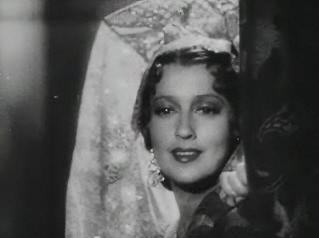
Jeanette MacDonald sparkles as a Spanish singer hired to
seduce French officers and learn their secrets during the
Napoleonic Wars
When you think of great movie duos of the '30s, of course the first two combos that pop to mind are Fred and Ginger--so famous you don't even need to give last names--then perhaps you think of William Powell and Myrna Loy, but not as many people today remember the huge popularity of  operetta stars Jeanette MacDonald and Nelson Eddy. They had a string of hit movies and songs going almost as long as Fred and Ginger, though, and remained popular until the post-modernism of the '60s and '70s dubbed them corny and outdated. That's actually a fair assessment of them since their movies were never heavy on plot but rather simple melodramas and romantic comedies designed to be vehicles for superb singing. And if you don't like operatic vocals, you're not going to like these films.

It's easy to see why Jeanette MacDonald became popular because she has a gorgeous soprano, glamorous looks, and an engaging personality. Nelson Eddy, on the other hand is a complete brick, despite his classic tenor, and renders their films almost unwatchable, especially in his early work. So of course my favorite Jeanette MacDonald operetta is one in which she co-stars with someone else.

Perhaps in 1937 someone realized that Nelson Eddy was a brick and tried to team Jeanette up with someone who could actually act. Fortunately they had another operatic tenor in Allan Jones, who made two movies with the Marx Brothers as well as a screen adaptation of Jerome Kern and Oscar Hammerstein II's immortal Show Boat.

Unfortunately audiences had become so accustomed to the stench of Nelson Eddy that they revolted when they got a whiff of a new man appearing with Jeanette MacDonald, and thus this film remains largely forgotten (so forgotten, in fact that I can't even find a copy of it on Amazon for a link). I ran into it for the first time on TCM's birthday tribute to Jeanette one year, and it instantly became a favorite for my family because it featured two memorable songs--"The Donkey Serenade" and "Gianina Mia," to be precise--and the plot was unusual and thus engaging.

Set in the Napoleonic Wars, The Firefly tells the story of a Spanish singer who seduces French officers in order to learn military secrets. Fortunately she manages to keep her heart disentangled until she meets the alarmingly persistent Don Diego (Allan Jones) who follows her on a key mission to France. Just when she's ready to give her heart to Diego, however, she finds out that he's really a French spy assigned to blow her cover, and she must retreat to Spain immediately. But even a spy with a blown cover can still have her uses, and Jeanette will find a way to stick it to the Frenchies.

Despite my affection for this movie, it's hardly a perfect film. Many of the battles, scenes, and montages seem extremely dated and clunky. In addition they show Jeanette singing at night clubs, which did not come into existence until the 20th century and thus are a gross anachronism. On the same note, the sets and costumes aren't terribly authentic either, but are kind of charmingly a product of their time, and since I love both Art Deco and Regency fashions, I don't mind terribly.

I give this film a 6.5 of 10: no great shakes, but enjoyable nonetheless.

Sunday, August 22, 2010

My Top 10 Fictional Boyfriends of Page and Screen

Fictional characters can be much more attractive than real people because they remain creatures of the imagination, and their faults do not intrude themselves upon our notice the way they would if they really existed. 

Apart from that they further endear themselves to us by being imprinted upon our consciousnesses as some of the most memorable narratives of all time. This process can work in reverse as well, as memorable characters can bring us back to stories we might not otherwise appreciate. While I'm not one of those people who's waiting for the perfect version of my favorite character to come along and woo me in real life, I have to admit to being rather enamored of certain creations of fancy. Today I'm going to honor the fictional men to whom I'd gladly give my hand in marriage if they existed--or at least I'd go on a date with them.

Honorable Mentions:

Rhett Butler was the prototype
for other charming rogues of
page and screen, and is
considered the defining role
for Hollywood legend Clark
Gable.
Rhett Butler, Gone with the Wind (Book especially)
  
I freely and openly admit to reading and watching Gone with the Wind purely for Rhett's sake. I can't stand Scarlett, but every time she comes across Rhett, I somehow have a wide grin on my face because I know she's about to get her comeuppance. Maybe it's genetic: my grandmother's favorite movie was Gone with the Wind because she was in love with Rhett, but it doesn't hit me quite as strongly as it did her.

In the novel, Rhett's passages would have me in stitches for minutes as he throws out one memorable quip after another. As much as I like Rhett, though, he really isn't a gentleman, as Scarlett so accurately points out, so he must fall down my list for that. Of course the reason for this fault is that Rhett is jaded and just smart enough to see all the problems in society and their causes without wanting to do anything about it.

Once his daughter is born, Rhett begins to reform for her sake, but his rocky relationship with then-wife Scarlett hinder his growth a lot. Perhaps what finally causes me to put him on this list is that he leaves Scarlett in the end, which shows good taste. Then again, it took him 12 years to figure out that she wasn't worth his time, so how smart can he really be?

I would perhaps go out once or twice with our dear Captain Butler, but I don't think I'd marry him even for his millions.


Hugh Laurie plays the Erstwhile Bertie Wooster
to perfection in the Jeeves and Wooster series.
 Bertie Wooster, Jeeves and Wooster (Books and TV series)

Bertie is kind of like a puppy dog that's always doing silly and adorable things, but he does lead a life of wealth and charm in the Art Deco elegance of the '20s and '30s, which has an undeniable attraction for me. I would love to go out to jazz clubs and the West End shows with Bertie or listening to him play Irving Berlin on the piano any time. 

Perhaps one of the reasons I love Bertie is that he always knows when he's getting himself into a scrape, but he does it anyway because the Code of the Woosters will not let him desert a friend in need. In addition in the books he has beguilingly casual way of narrating that make it seem like a prolonged story told anecdotally by your best friend, and compels you to try to read it all in one sitting because you flow through it all so easily.

Bertie is not a complete dolt, either, since he won a scripture knowledge prize at Eton, and he's always making quotes, though he doesn't always get them right. Compared to some of his friends like Barmy and Bingo, moreover, Bertie looks like quite a wit.

Hugh Laurie portrays Bertie to perfection in the Jeeves and Wooster series co-starring Stephen Fry as the inimitable Jeeves. Laurie captures Bertie's joy, his reluctant sense of duty that causes him to enter willingly into misery, and his comprehension of just how fishy things are when he's being put upon. 

Like my last entry, I'd love to have Bertie for a casual boyfriend, but I don't think I'd marry him unless it was to save him from Honoria Glossip, Madeline Basset, and Lady Florence Craye. Besides, Jeeves would probably find me unsuitable.

Angus "Mac" MacGuyver (MacGuyver TV Series)

Richard Dean Anderson portrays MacGuyver
the man who defeats the Communists using
only his wits for weapons. If only he'd lose the mullet...
MacGuyver would probably be higher on my list, but there's a lot of other guys I like out there, and I already have another character portrayed by Richard Dean Anderson higher on the list, so I'm content with keeping Mac as an honorable mention. Plus he gets negative points for the mullet. Sex appeal is a factor, after all.

Why is MacGuyver still so appealing, though? Well, he gets points for battling the communists, and even more points for doing it without using guns. Instead Mac relies on his uncanny ability to use his wits, surroundings, and the things in his pockets to stymie his enemies. He's so amazing that his name has become a verb, meaning to jerry-rig something.

So yes, brains and daring are both good, but MacGuyver gets extra points for being immaculately good. He never refuses helping someone in trouble, especially kids and women. He also gets points for still wanting to fight and stop the bad guys even if he doesn't believe in killing. There is already a real knight on this list, but Mac is probably the closest thing you can get to one in the modern era.

The List:

10. Ralph Touchett, The Portrait of a Lady, (Book only) 

Sadly the silver screen has yet to be graced by a really good Ralph. Although there was a rubbish version of the book that came out in the '90s, that Ralph had no sense of humor, and therefore no charm for the audience. The laconic cousin of heroine Isabel Archer is supposed to watch the world with the detached amusement of a man who knows he's dying of consumption, detached, that is until his heart inadvertently gets involved.

His hopeless love for Isabel causes his father to change his will to make Isobel financially independent, but this, unfortunately makes her the victim of a fortune hunter who abuses Isobel terribly after her marriage. Ralph would have gone to his grave loving her in silence had she not forced him to admit his reason for trying to interfere with her then-intended marriage. Of course Isobel only figures out her true feelings about Ralph when he's on his deathbed, and thankfully the story ends with the most compelling character dead.

I think my favorite passages of the book are when Ralph is arguing with Isobel's suffragette friend Henrietta Stackpole. It's not that Ralph doesn't respect her, but he just can't resist playing the devil's advocate with her, much to everyone's amusement. They eventually, however, become friends when Henrietta realizes that Ralph is just kidding around. Ralph and all the rest of the list I'd definitely marry if one of them asked me.

9. Han Solo, original Star Wars trilogy, especially The Empire Strikes Back.

Han Solo arguing with with the Princess, as he does through
most of The Empire Strikes Back.
Han was probably my first screen crush as a kid when I saw him in wooing Princess Leia in The Empire Strikes Back at the age of 9. Handsome Harrison Ford plays a lovable scoundrel plagued with bad luck as his rickety old space freighter keeps breaking down while half the imperial fleet is in pursuit.

As charming as he can be when dueling wits with the princess, when he really wins our hearts is when he faces what probably will be his death with such nobility. First he asks his best friend Chewbacca to take care of Leia for him, then even as the stormtroopers drag him away, his gaze remains on his lady love until the last moment when he descends into the freezing chamber. The expression of agony imprinted on his face as the haul him back up again remains imprinted on our hearts forever.

Heartthrob Errol Flynn plays Robin Hood better than anyone
else when he starred in 1938's The Adventures of Robin Hood.
7. Robin Hood (1938 film)

Noble, fun-loving, and handsome, the Errol Flynn version of presents what is perhaps the sexiest version of Robin Hood ever. We really believe his romance with Maid Marion, appreciating the gentle way in which he shows her that her views on the tax problem are in error instead of lording it over her like a jerk.

Other than that, he's Robin Hood for goodness sake, and who doesn't love Robin Hood? Steals from the rich, gives to the poor, taunts the Sheriff of Nottingham, duels with Guy of Guisborne, give hammy speeches about justice and freedom; what's not to like?

7. Col. (later Gen.) Jack O'Neill, USAF (Stargate SG1 only)

Always snarky, always entertaining, Jack
O'Neil made Stargate SG1 a great show that's
spawned a bevy of second-rate spin-offs.
I'm hoping this is a controversial call, but as much as I love MacGuyver, I still prefer the character Richard Dean Anderson portrayed ten years later, Col. Jack O'Neill. Actually Anderson himself deserves a lot of credit for making the character memorable and lovable. 

Stargate was based on a movie of the same title in which Jack was a depressed US Air Force officer driven to suicide when his son kills himself while playing with Jack's gun. When Anderson took over the character for the TV series, however, he injected wit and vivacity into this role. After all, how can you not find some irony in a man who makes a living getting in way over his head at a top secret facility in which modern day US soldiers save the earth from alien threats and conceal their existence from the world? Certainly if such a situation were real, a healthy sense of humor might be the best way to get through it without becoming a basket case. Jack became not so much a character but a projection of Anderson's own goofy sense of humor. Actually, it's a good analogy to what he did to the show: just as Jack's character could have been dark and brooding, the show could have been an angst fest, but Jack's tongue-in-cheek comments keep it light and enjoyable.

Although very smart, Jack's constantly surrounded by people much smarter than him. In fact the team he leads features two PHDs: archeologist Daniel Jackson, and astrophysicist Maj. Samantha Carter. Jack, on the other hand, besides being a combat expert from twenty years in Special Forces, is really only good a correcting people's grammar. So instead of feigning the ability understand what his colleagues are saying, he'll purposely and self-deprecatingly mangle their big words so that they have explain it to him in the simplest terms possible. When you think about it, though, that really is the smartest thing to do because then he gets the clearest understanding of the situation possible, which he needs for the leadership decisions he's constantly forced to make.

Jack is just one of the funnest characters to watch of all time. He's always making sports metaphors, taunting his enemies, cracking Star Trek and Star Wars jokes, and fishing in a pond that has no fish in it. Perhaps one of the best example is when he and SG1 are afraid they've altered the space-time continuum, he leaves his alternate self this message to see if the world is all right, "College football is played on Saturday, pro on Sunday. And there are no fish in my pond." Now that's a man who has his priorities straight! Or maybe I prefer the time when he's trapped in 1969 and give his name as "Captain James T. Kirk of the Starship Enterprise." and then corrects himself, "I'll be honest with you. My name's not Kirk. It's Skywalker. Luke Skywalker."

What I really admire most about Jack, though, is that despite being hopelessly irreverent, he really is impressively noble. The best example I can think of this are two instances. The fist is his relentless refusal to overstep ethical boundaries and have a romantic relationship with Carter even though they are deeply in love with each other (Jack is her direct superior, so fraternization would be really unethical). Even when he's stuck in a Groundhog-Day-style time loop in which he knows his actions will carry no consequences on reality, he still hands in his resignation to General Hammond before he indulges in a long, passionate kiss with Carter. The other time is when he willingly sacrifices himself to a slow, painful death in order to save the earth because when it came down to a choice between him and one of the members of his team, he valued their lives more than his own.

6. Ned Henry, To Say Nothing of the Dog by Connie Willis (published 1997)

Ned was written to be an everyman character, but he's so much more than that. His gallows humor and senses of irony and absurdity form the axis around which the story moves, much in the same way that Bertie Wooster does this. Some of my favorite examples of his commentary are when he says that someone with time-lag is sentimental as "an Irishman on his cups or a Victorian poet dead sober," or when he dubs Tossie's squeals to be "screamlets" and then proceeds to use his newly-coined term for the rest of the book. These are the kind of things that make him the most amusing narrator since Bertie Wooster, and since he is much smarter than the aforementioned gentleman, so is his style of humor.

Just to prove how exceptional Ned is, the heroine of To Say Nothing of the Dog falls in love with him because she reminds him of the character who ranks #1 on this list. Certainly they do have quite a bit in common being that they are both MAs in history from the same college at Oxford with great senses of humor, but I think the rest of her admiration must be due to time-lag, which is why there are four more entries between this and my absolute favorite.

Sink me! It's the Scarlet Pimpernel portrayed by Anthony
Andrews in this 1982 classic, which doesn't quite follow the book.
5. Sir Percy Blakeney, The Scarlet Pimpernel (Book, 1934 film, 1982 film)

"Is he in heaven?" I don't know, but when I read the book or watch one of the movies, I always answer an ephatic "YES!" Although he pretends to be an idiotic fop in the light of day, the English baronet is really the mastermind behind rescuing innocent aristocrats from the guillotine in Revolutionary France. The way he makes a fool out of French agent Chauvelin over his cravat is priceless, and the many ingenious disguises he dons leave me grinning like an idiot whenever I see them. And speaking of idiots, I confess I am delighted whenever I watch Sir Percy go into his idiot act.

Percy, however, has a fatal flaw: his love for his wife which causes him to fly into an irrational anger and feud with her for months by snubbing her and concealing everything under his idiot demeanor. What bothers me most is that he condemns her character without letting her explain or trusting in her innocence as she asks him to. If his faith in his wife can be shaken so easily it seems to me that his love for her is either shallow or based on the wrong qualities. Of course she is exonerated in the end, and he learns his lesson, saving her in a way that is so clever in the book (and has sadly never been reproduced accurately in a film) that I seem to forgive him every time--well, almost forgive him, anyway.

Both Anthony Andrews and Leslie Howard play Sir Percy exceptionally well, and so I recommend both the 1930s and 1980s versions of the film even though I like the Anthony Andrews version slightly better because of two good performances by Jane Seymour as Marguerite and Ian McKellen as Chauvelin.

4. Indiana Jones (Raiders and Last Crusade only) 


I'm certainly not the first or only woman in the world to fancy Indiana Jones. Who wouldn't want a man who was a professor by day and a an action hero by night?

As I do not like either The Temple of Doom or Kingdom of the Crystal Skull--just the titles makes me want to retch--I do not include them here. I seem to have a thing for fictional gents that lived in the '30s: Bertie, Indy, and the #1 on my list coming up. Maybe it's the fedoras. Harrison Ford looks undeniably dashing in that hat...

No, I think it's more than that. Indy has an undeniable zeal for the truth and to see treasures of art and history able to be studied and enjoyed by the people. He befriends the natives of the areas he visits, and deeply respects their cultures; he is chivalrous towards women and ruthless towards his enemies, especially when he's up against the Nazis.

When teamed up with his dad in Last Crusade, Indy's snarky sense of humor comes out for the first time to thunderous applause. That movie is particularly endearing because it shows us that Indy can be just as engaging when he is skating by on his wits, dodging the Nazis that way as he can be when he's beating them up. If I have one complaint against Indy it's that he didn't marry Marion when he had the chance. She was the only woman who was ever really a match for him, even if she did suffer from damsel-in-distress syndrome. 


3. Sir Wilfred of Ivanhoe, Ivanhoe (Book only)

As far as knights in shining armor go, they don't get any shiner than Sir Wilfred of Ivanhoe. Sir Walter Scott is famed for pioneering the historical fiction genre, and Ivanhoe was perhaps his boldest foray into the past. In this tale of Anglo-Norman feuding, Wilfred is a good Saxon boy who years ago decided to follow England's Norman king, Richard the Lion-Hearted, on the Third Crusade, against the will of his father.

Years later the disinherited knight returns to England to find his father and his lady love Rowena being harassed by their Norman neighbors, mostly vying for the hand of the said Rowena. He wins our respect instantly by befriending a vulnerable Jewish family in the face of overbearing antisemitism. He not only honors the beautiful Rebecca at a jousting tournament but he also saves her from an ecclesiastical court that wants to burn her for witchcraft. To do this he must fight to the death against the fearsome Brian du Bois-Guilbert and do so while while severely injured.

If you're looking for a man with bravery, morality, and compassion, you can't do better than Sir Wilfred, in my opinion. As for his marriageability, I don't think you could find a man in either fiction or reality that would make as ardent or as sincere of a lover. My only problem is that his sense of humor is still untested, and my strong sense of absurdity needs a man who can complement. that.

Famous Austenian wit Henry Tilney jokes with Catherine
Moorland about the terrors that await as his family's
Gothic abode, Northanger Abbey
2. Henry Tilney, Northanger Abbey (Book especially, but 2007 movie version as well).

I've been madly and hopelessly in love with Henry Tilney since I first read Northanger Abbey when I was 14. Many Austen fans love such heroes as Mr. Darcy, Captain Wentworth, and Mr. Knightley, but none of these men can hold a candle to the wit, mirth, charm, and wisdom of Henry Tilney, younger son of General Tilney of Northanger Abbey.

Mr. Tilney catches our eye for the beginning with his taste for satire and love of books. "The person," he tells our heroine Catherine Moorland, "be it man or woman who has not pleasure in a good novel must be profoundly stupid," and thus he permanently endears himself both to her and us. His conversation about literature and life with Catherine and his sister Eleanor as they go on their walk is probably one of the best passages Austen ever wrote.

My only point against Henry Tilney is that he marries Catherine who is so obviously his intellectual inferior. As Dorothy Sayers points out, men of genius are often applauded for marrying inferior women, but women of genius do not have that luxury. Even Austen herself had to admit in the final chapter that her charming Henry was stooping a little in marrying her heroine. The 2007 version by the BBC captured the essence of the character while cutting most of his best dialog in a most inexcusable way. My approbation therefore, is only partial.

1. Lord Peter Wimsey, The Lord Peter Mysteries (Books only)

Image of Lord Peter, based on Edward Petherbridge, the actor
who portrayed him in the 1987 TV series.
As yet there has been no really spot-on film portrayal of the most attractive man in all of fiction. His author Dorothy L. Sayers once described him as a combination of Fred Astaire and Bertie Wooster (and ironically he has a butler whom he often scolds for pretending to be Jeeves), but while that description covers his charm and humor, it short-changes his intelligence.


An MA in history from Balliol College, Oxford University, Lord Peter worked both in combat and in the Intelligence Service during the Great War, surviving that conflict with severe post-traumatic stress syndrome after being badly injured by artillery fire This mental affliction still troubles him occasionally in the books, especially the early ones, and he compensates for it by putting on an air of frivolity and wit, sometimes at inappropriate moments. 

Upon returning to civilian life, Lord Peter takes up sleuthing as a way to occupy his substantial brain when he is not working as a diplomat--he is fluent in French and Latin, breaking into quotations whenever he feels so inclined--or indulging his love for music (especially Bach). Like most men, he also loves fast cars--he named his roadster Mrs. Merdle after the Dickens character. How geeky/cool is that!--good food and wine, and the company of the opposite sex.

Lord Peter is my ultimate idea of what I'd like in a man. On the surface he's a charming gentleman who will kiss your hand and fill your ear with witty banter over dinner and then gracefully dancing your feet off, but he's also a deep thinker and feeler with a strong sense of morality and duty. I think my two favorite quotes of his that sum up why I like him are: "I always have a quotation for everything. It saves original thinking," and "The only real sin passion can commit is to be joyless."

As charming as Lord Peter is normally, his charm quintuples whenever he is in the presence of his great flame Harriet Vane. First of all it raises my opinion of his character that he's the only one who does not unfairly condemn Harriet when she's on trial for murder just because she used to live with the victim outside of wedlock. While the rest of the people looked on her refusal to marry her lover when he asked her as proof of her moral depravity and anti-social tendencies, Wimsey sees that she decided to leave her boyfriend because he was manipulating her, and Wimsey applauds her decision. It's also incredibly endearing to see the normally suave Wimsey fumbling and awkward whenever he encounters his true love; it makes the great man human. All of Peter's faults, in fact, come out in his courtship with Harriet. His vanity injured by her repeated spurning of the offer of his heart, he retreats behind his veneer of frivolous wit and jocularity, turning his romantic overtures into a joke at his own expense. Concealed behind this mask, Peter takes six painful years and a trip to the purifying air of Oxford before he allows Harriet, who values honesty above everything, to see the real Lord Peter Wimsey and fall in love with him.