Lately I've been finding a lot of really remarkable films to review that fly in the face of my general rule that (a) not many good movies were made during the Second World War, and (b) those that deal directly with the conflict are often the worst. This rule should be doubly true for British films, moreover, since that country was so decimated by the conflict. So the fact that Pimpernel Smith is even remotely entertaining, since it is a British film dealing with the war, is something of a minor miracle.
Needless to say, I was extremely apprehensive viewing this movie because it had both the potential to be quite good and, of course, the potential to be abysmal. In it's favor are the facts that it stars Leslie Howard and is a modern retelling of the classic novel The Scarlet Pimpernel. Against it is the fact that it is a war film, which means some really obvious pro-war rhetoric - some would say propaganda. In addition the lack of resources in terms of actors, many of whom joined up, and supplies makes a lot of war films look amateurish as well.
Howard, of course, had already starred in the 1934 adaptation of the The Scarlet Pimpernel, and cut a very dashing figure as Sir Percy Blakeney, so he seemed an obvious choice for the Blakeney character in the remake. Of course he doesn't disappoint in this version either, and really almost carries it single-handedly, especially since he was also the producer and director.
In this re-imagining, Howard plays Professor Smith, an eccentric Cambridge don who smuggles enemies of the state out of pre-war Germany under the guise of doing archaeological digs on early Aryan civilization. This immediately gave me the delicious idea, "Mild-mannered professor by day and action hero by night? Sounds like an early version of Indiana Jones." With the Nazis furiously trying to uncover his identity, Smith returns to Germany with a group of students who are unaware of the true purpose for his trip. They discover the truth, however, when a narrow escape leaves their beloved professor wounded, and quickly join his cause. Then, there's the Marguerite character, blackmailed by the Nazis into uncovering Smith's identity. She pegs him immediately, to the incredulity of the Nazis, who can't conceive how anyone as innocuous as Professor Smith could spearhead such daring rescues. She changes her tune when she realizes that Smith could deliver her father, but when the Nazis realize her duplicity, Smith ends up having to rescue her too.
The film does a good job of balancing the nationalistic rhetoric and still telling an entertaining story. I can't say this film is on the level of Casablanca, but then, what is? I commend it for a laugh-out-loud funny seen in which a bunch of Nazis trying to understand English humor and being absolutely baffled by P.G. Wodehouse and Lewis Carroll. Howard sparkles in all of his scenes, laconically brilliant in professorial mode, and not so overly heroic to defy credulity. Perhaps the one serious blight is the one American student, not because there's anything wrong with the character, but because the actor couldn't do an American accent to save his soul; instead he sounds vaguely Welsh, possibly Scottish, which is quite disconcerting (in fact it took me half an hour to figure out that he was supposed to be from the U.S.). I was also impressed with how well they mirrored key points of the novel without sticking so close to the source material that it seemed like a mere modernization.
I give this film a 7.2, quite high considering its a British-made war film.
Showing posts with label obscure films. Show all posts
Tuesday, August 2, 2011
Tuesday, December 7, 2010
Fitzwilly (1967)
For the rest of the month, I intend to review Christmas films, and while Fitzwilly isn't a traditional feel-good holiday movie, it does take place entirely at Christmastime, so I figured I'd put it in, especially since Turner Classic Movies was featuring it on their lineup of Christmas movies. This film is so rare, moreover, that it deserves to be reviewed while it's still fresh in my mind.
This charmer stars Dick Van Dyke as the butler Fitzwilliam, affectionately known to his employer Miss Vicki as Fitzwilly. The son of a butler, Fitzwilly was taken in by Miss Vicki when his parents died suddenly and was given an Ivy League education to complement his considerable mental faculties. Out of filial devotion to Miss Vicki, he looks after her as both her butler and the steward of her estate.
Unbeknown to Miss Vicki, she has gone broke giving away her money to charities, so in order to support her in the manner to which she is accustomed, Fitzwilly starts pulling elaborate heists and scams, all of which Miss Vicki remains in ignorance. Ironically, almost all the money Fitzwilly makes gets given by Miss Vicki to charities, so he can never amass enough capital to give up the life of crime. In addition we get the feeling that Fiztwilly enjoys the thrill of heist, so it's not much of a sacrifice on his part.
The whole arrangement comes into jeopardy, however, when Miss Vicki hires a secretary named Juliet--played by Get Smart's Barbara Feldon--to edit the book she's writing. At first she loathes Fitzwilly's controlling ways, but sensing a deeper story hidden underneath his unorthodox way of running the houshold, she soon finds herself falling in love with the cunning butler. Her investigations, however, nearly prove fatal to the gang's thieving operations. When she learns the truth of the source of Miss Vicki's income, Juliet makes Fitzwilly promise to give up his life of crime before they get married, so he plans one last grand heist to ensure that Miss Vicki will never have to worry about money again.
Being a simple face, this film doesn't need a believable premise to be enjoyable, and it succeeds in providing us with plenty of amusing situations and some really ingenious heists. It's a not laugh-out-loud funny movie, but it certainly holds our interest for an hour and a half. Barbara Feldon and Dick Van Dyke prove themselves to be just as entertaining on the big screen as they were on the small, and I especially appreciate that there's no estrangement between their characters when she finds out the truth about his job because that's such a cliche. In addition the character actors never fail to delight, especially Edith Evans as Miss Vicki and John McGiver as the butler Albert.
I give this film a 6.7 out of 10. It's not brilliant, but it's smart enough to be one of Blackadder's cunning plans.
This charmer stars Dick Van Dyke as the butler Fitzwilliam, affectionately known to his employer Miss Vicki as Fitzwilly. The son of a butler, Fitzwilly was taken in by Miss Vicki when his parents died suddenly and was given an Ivy League education to complement his considerable mental faculties. Out of filial devotion to Miss Vicki, he looks after her as both her butler and the steward of her estate.
Unbeknown to Miss Vicki, she has gone broke giving away her money to charities, so in order to support her in the manner to which she is accustomed, Fitzwilly starts pulling elaborate heists and scams, all of which Miss Vicki remains in ignorance. Ironically, almost all the money Fitzwilly makes gets given by Miss Vicki to charities, so he can never amass enough capital to give up the life of crime. In addition we get the feeling that Fiztwilly enjoys the thrill of heist, so it's not much of a sacrifice on his part.
The whole arrangement comes into jeopardy, however, when Miss Vicki hires a secretary named Juliet--played by Get Smart's Barbara Feldon--to edit the book she's writing. At first she loathes Fitzwilly's controlling ways, but sensing a deeper story hidden underneath his unorthodox way of running the houshold, she soon finds herself falling in love with the cunning butler. Her investigations, however, nearly prove fatal to the gang's thieving operations. When she learns the truth of the source of Miss Vicki's income, Juliet makes Fitzwilly promise to give up his life of crime before they get married, so he plans one last grand heist to ensure that Miss Vicki will never have to worry about money again.
Being a simple face, this film doesn't need a believable premise to be enjoyable, and it succeeds in providing us with plenty of amusing situations and some really ingenious heists. It's a not laugh-out-loud funny movie, but it certainly holds our interest for an hour and a half. Barbara Feldon and Dick Van Dyke prove themselves to be just as entertaining on the big screen as they were on the small, and I especially appreciate that there's no estrangement between their characters when she finds out the truth about his job because that's such a cliche. In addition the character actors never fail to delight, especially Edith Evans as Miss Vicki and John McGiver as the butler Albert.
I give this film a 6.7 out of 10. It's not brilliant, but it's smart enough to be one of Blackadder's cunning plans.
Monday, September 13, 2010
Film Review: The Sky's the Limit (1943)
![]() |
| War pilot Fred Astaire pretends to be a drifter while wooing Joan Leslie in The Sky's the Limit. |
Still, I'm of the opinion that a movie featuring the greatest dancer ever to grace the silver screen can't be without some merit, even if it's a piece of wartime fluff such as this, which I normally condemn on principle. For Astaire fans I would say that this movie is certainly worth viewing because in Fred's three dance numbers his performance do not fail to disappoint. Not only did Astaire choreograph all his dances himself, but he took pains to ensure each had a unique look to it in order both to show his versatility and to keep from being a one-note performer. As a connoisseur of Fred Astaire, therefore, I cannot help looking with admiration and delight at each of his numbers.
So what's this movie about besides and hour and a half (pardon the bad joke)? Well, just as I remembered, Fred plays a decorated fighter pilot on leave who is being paraded around the country as a poster-boy/moral-booster. Tired of being on the pedestal with no time to relax, he ditches his unit and goes roaming across the country, ending up in NYC where he falls in love with a lovely photographer played by Joan Leslie. The only problem is that Fred doesn't want to tell her he's a war hero because--he says but doesn't elaborate sufficiently--he fears that she would have him talking about nothing else since her dream is to be a war correspondent.
Perhaps I'm too removed from that wartime generation to get it, but this motivation seems dreadfully insufficient to me, especially since it significantly hinders his courtship with the girl he likes, and he only has a short time in which to woo her. To me this is just laziness on the part of the screenwriters. It's a lame excuse in order to draw out the plot, especially when there could be lots of more believable reasons why he'd want to conceal his identity from her and that would still serve the purpose they wanted plot-wise.
In addition the film suffers from an uninspired writing for the minor characters, something that's usually vital for a romantic comedy. For example they had a potential for a lot of humor out of the fact that Joan Leslie entertains in a soldiers' canteen, and when Fred follows her there pretending to be a civilian, he runs into the other members of his squadron, who don't torment him nearly as much as they should to make a comedy really entertaining. Again, this speaks of laziness on the writer's part.
Inspired plots, however, are not the reason people go to see musicals. That can be easily forgiven if the signing and dancing is good enough. Is it, though, in this case? Yes and no. There are only three musical numbers in the whole movie, and while that's not nearly enough to carry us through ninety minutes, the three numbers are quite good. The score by Harold Arlen and Johnny Mercer features the immortal "One More for My Baby," which would also be featured in the much better film Cover Girl the next year, and two more songs which, while not fabulous are sweet and appropriate. I've already hinted that Astaire's dancing is inspired, but now let me say that he treats us to a vaudeville-style light duet with Joan Leslie, which is cute and peppy, a passionate love piece, and a drunken despairing solo of "One More for My Baby." I know a good performance should always leave us wanting more, but in this case it's so little as to make us feel cheated.
Fred Astaire is such a superb performer that I'm going to give him a 6 out of 10 just for being himself and giving us some entertaining songs and dances, but he's the only asset this film has.
Buy it now:
The Sky's the Limit [VHS]
Tuesday, August 24, 2010
Film Review: The Firefly (1937)
![]() |
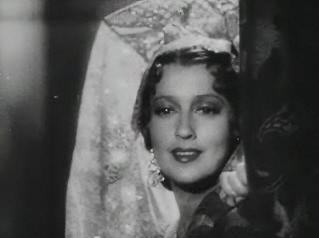
| Jeanette MacDonald sparkles as a Spanish singer hired to seduce French officers and learn their secrets during the Napoleonic Wars |
It's easy to see why Jeanette MacDonald became popular because she has a gorgeous soprano, glamorous looks, and an engaging personality. Nelson Eddy, on the other hand is a complete brick, despite his classic tenor, and renders their films almost unwatchable, especially in his early work. So of course my favorite Jeanette MacDonald operetta is one in which she co-stars with someone else.
Perhaps in 1937 someone realized that Nelson Eddy was a brick and tried to team Jeanette up with someone who could actually act. Fortunately they had another operatic tenor in Allan Jones, who made two movies with the Marx Brothers as well as a screen adaptation of Jerome Kern and Oscar Hammerstein II's immortal Show Boat.
Unfortunately audiences had become so accustomed to the stench of Nelson Eddy that they revolted when they got a whiff of a new man appearing with Jeanette MacDonald, and thus this film remains largely forgotten (so forgotten, in fact that I can't even find a copy of it on Amazon for a link). I ran into it for the first time on TCM's birthday tribute to Jeanette one year, and it instantly became a favorite for my family because it featured two memorable songs--"The Donkey Serenade" and "Gianina Mia," to be precise--and the plot was unusual and thus engaging.
Set in the Napoleonic Wars, The Firefly tells the story of a Spanish singer who seduces French officers in order to learn military secrets. Fortunately she manages to keep her heart disentangled until she meets the alarmingly persistent Don Diego (Allan Jones) who follows her on a key mission to France. Just when she's ready to give her heart to Diego, however, she finds out that he's really a French spy assigned to blow her cover, and she must retreat to Spain immediately. But even a spy with a blown cover can still have her uses, and Jeanette will find a way to stick it to the Frenchies.
Despite my affection for this movie, it's hardly a perfect film. Many of the battles, scenes, and montages seem extremely dated and clunky. In addition they show Jeanette singing at night clubs, which did not come into existence until the 20th century and thus are a gross anachronism. On the same note, the sets and costumes aren't terribly authentic either, but are kind of charmingly a product of their time, and since I love both Art Deco and Regency fashions, I don't mind terribly.
I give this film a 6.5 of 10: no great shakes, but enjoyable nonetheless.
Subscribe to:
Posts (Atom)